Your Martech Stack’s Most Expensive Integration Is Still a Human
There is a strange moment in marketing technology right now.
AI agents can draft an account brief, assemble an audience, personalize a nurture stream, and recommend a next-best action in seconds. Yet many of the records feeding those systems still arrive as spreadsheets attached to email.
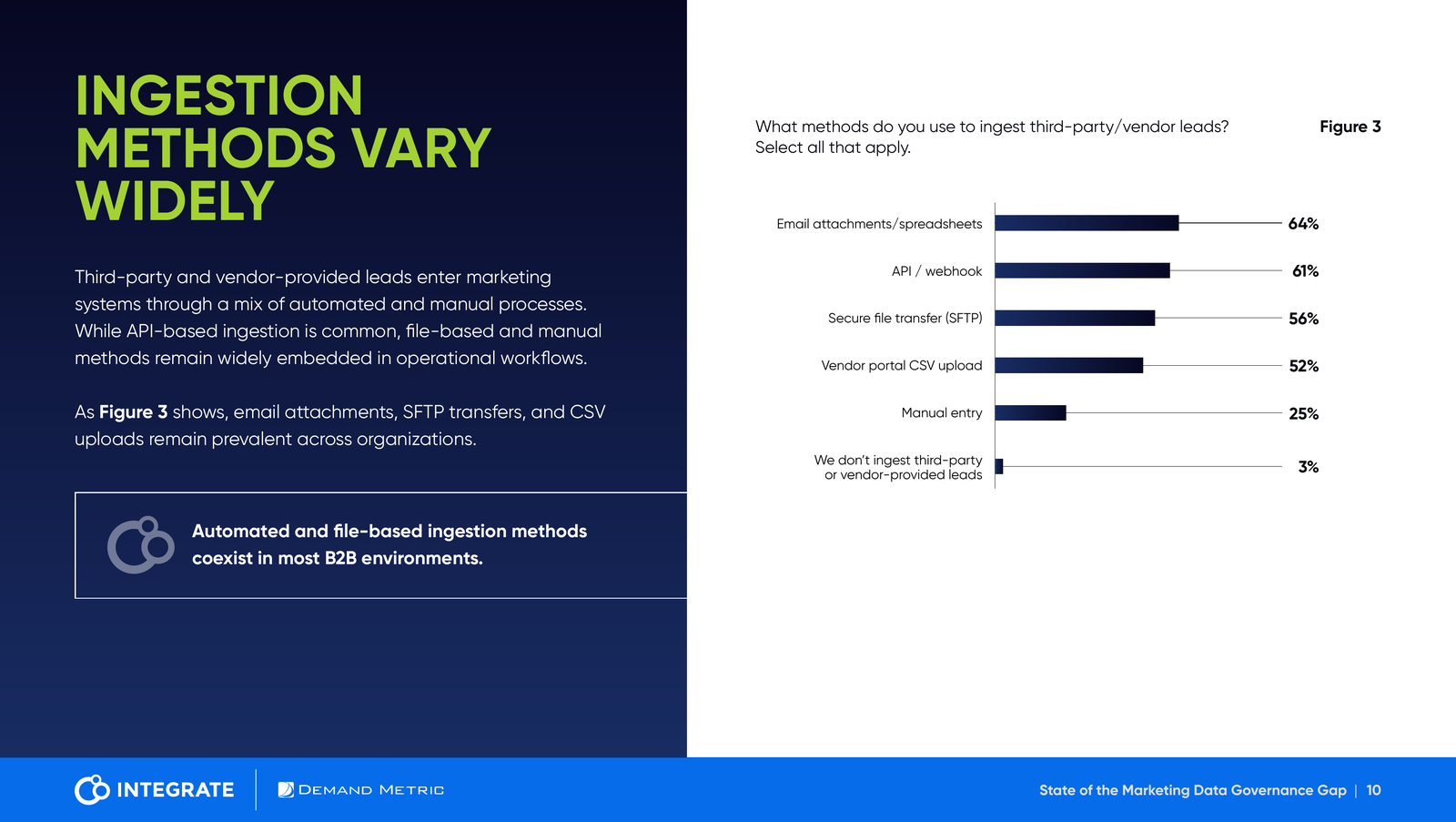
That is not a hypothetical edge case. In the final 2026 State of the Marketing Data Governance Gap report from Integrate and Demand Metric, 64% of respondents said they ingest third-party or vendor leads through email attachments or spreadsheets. At the same time, 61% use APIs or webhooks, 56% use secure file transfer, and 52% use vendor-portal CSV uploads.
The old and new have not replaced each other. They have accumulated.
The result is what the report calls the manual automation paradox: increasingly sophisticated B2B technology environments held together by human reconciliation, exception handling, and cleanup. The stack may be modern. The flow through it often is not.
Executive takeaways
- The gap between faster-growing and slower-growing B2B organizations appears to be structural, not simply technological.
- High-growth teams govern data earlier, validate it before it reaches the CRM, route it faster, and earn greater trust from Sales.
- AI raises the value of governed data and the cost of weak inputs at the same time.
- As Q4 approaches, CMOs should focus less on another platform purchase and more on redesigning two or three revenue-critical data flows end to end.
What is the marketing data governance gap?
The marketing data governance gap is the difference between owning modern data and Martech systems and operating them with consistent intake standards, upstream validation, disciplined routing, clear accountability, and formal AI oversight.
The report's real headline: growth leaders operate differently
The study surveyed 245 marketing, revenue operations, and commercial operations leaders across B2B and B2B2C organizations in Q1 2026. CRM use was required, which gave every respondent a common system-of-record baseline.
The most important finding is not a single percentage. It is the consistency of the pattern across the commercial system.
Compared with flat or declining organizations, high-growth organizations were:
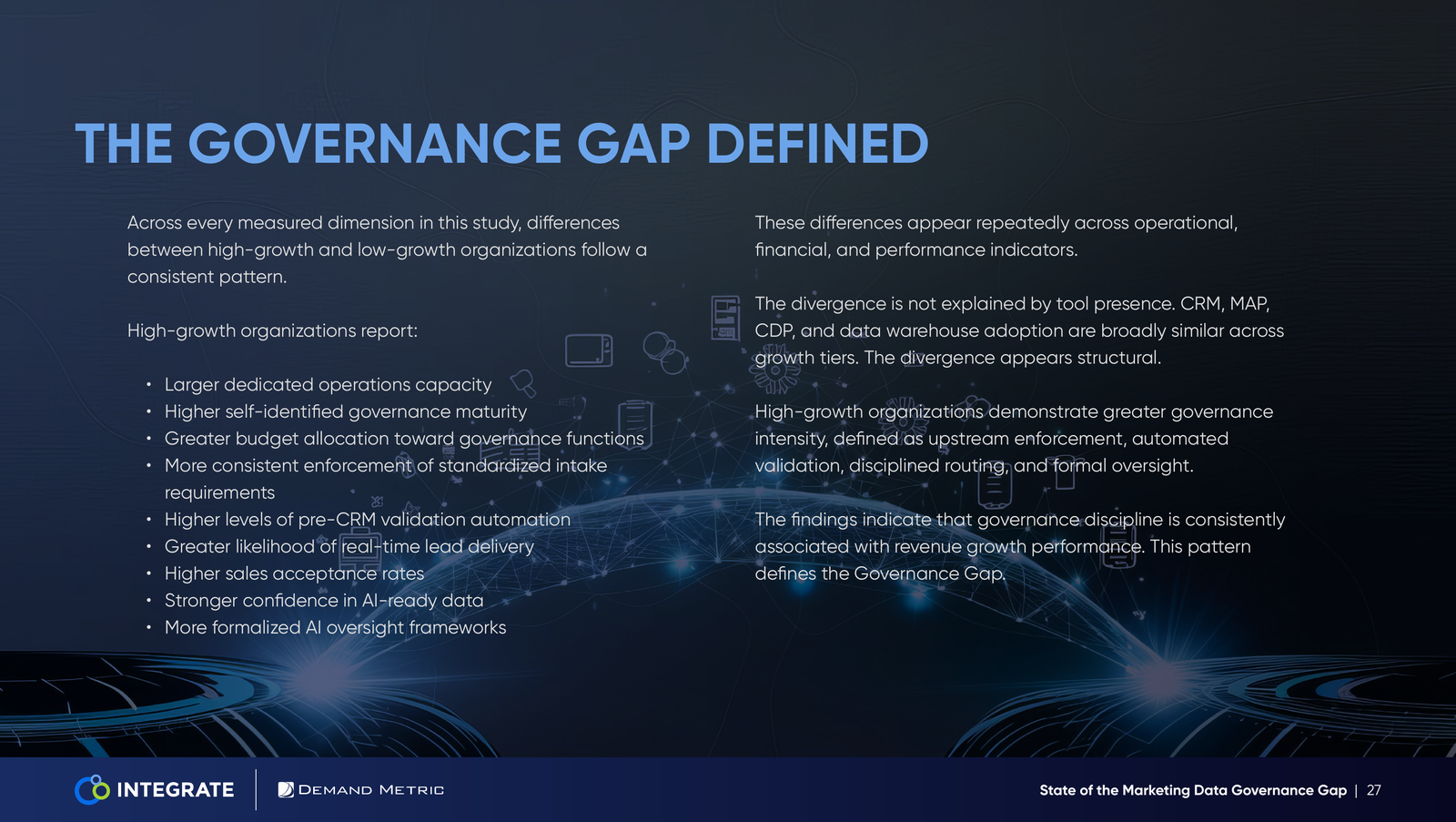
- nearly four times more likely to rate their data-governance maturity as advanced or leading, at 57% versus 14%;
- nearly four times more likely to strongly enforce standardized vendor-intake requirements, at 39% versus 10%;
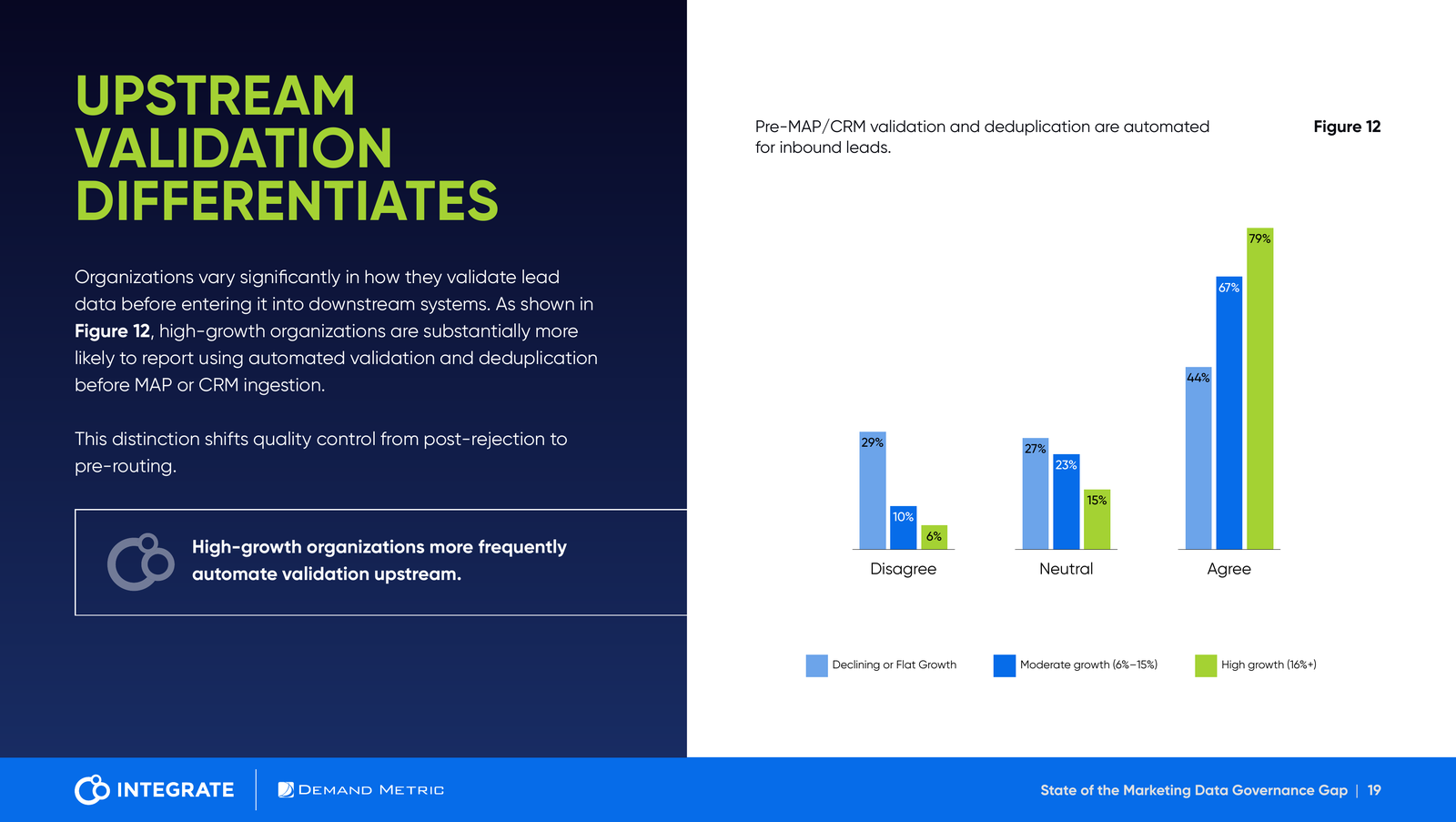
- much more likely to automate validation before CRM ingestion, at 79% versus 44%;
- more than twice as likely to deliver vendor and event leads to Sales in real time or near real time, at 45% versus 17%; and
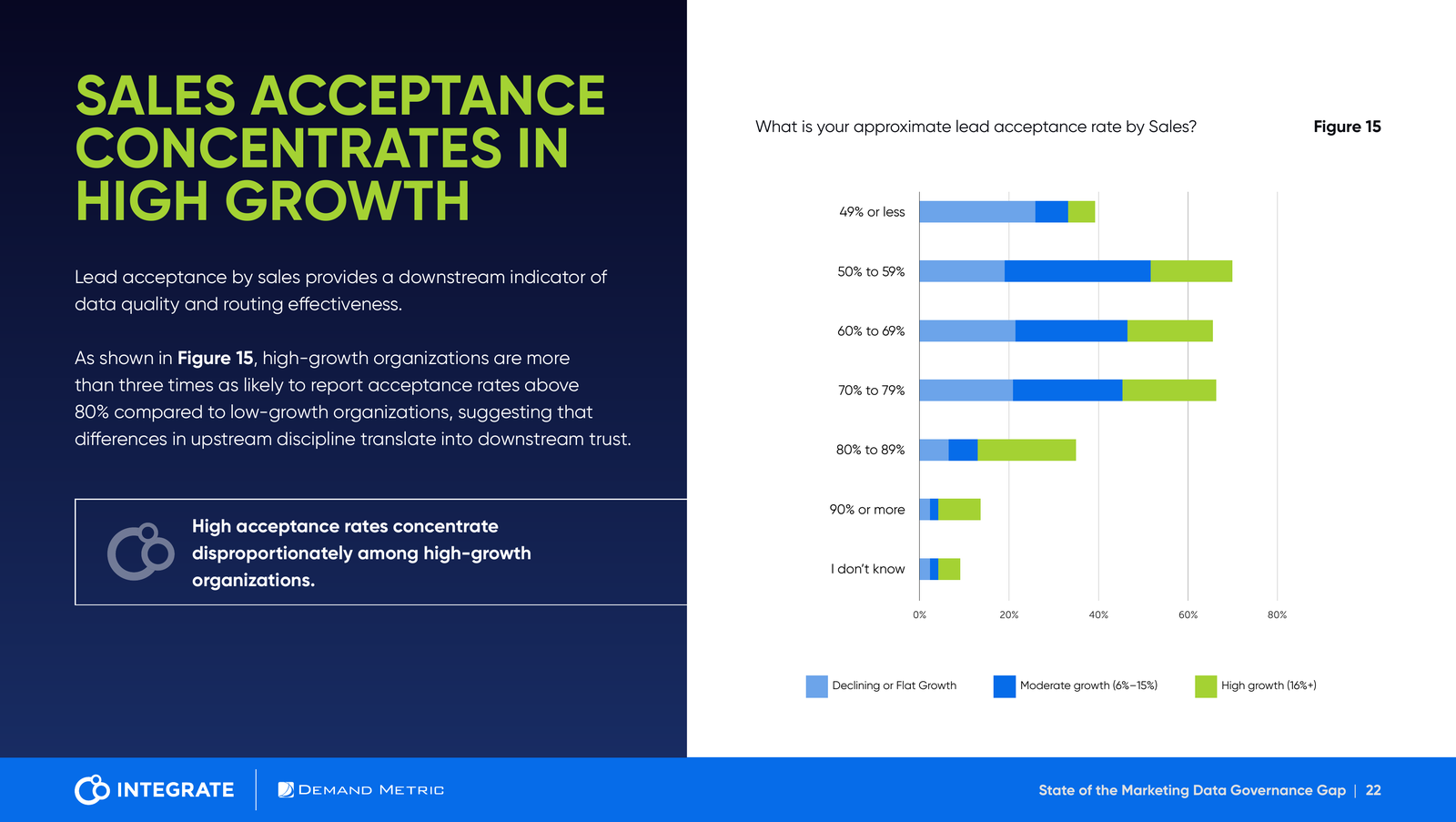
- more than three times as likely to report sales acceptance rates of at least 80%, at 31% versus 9%.
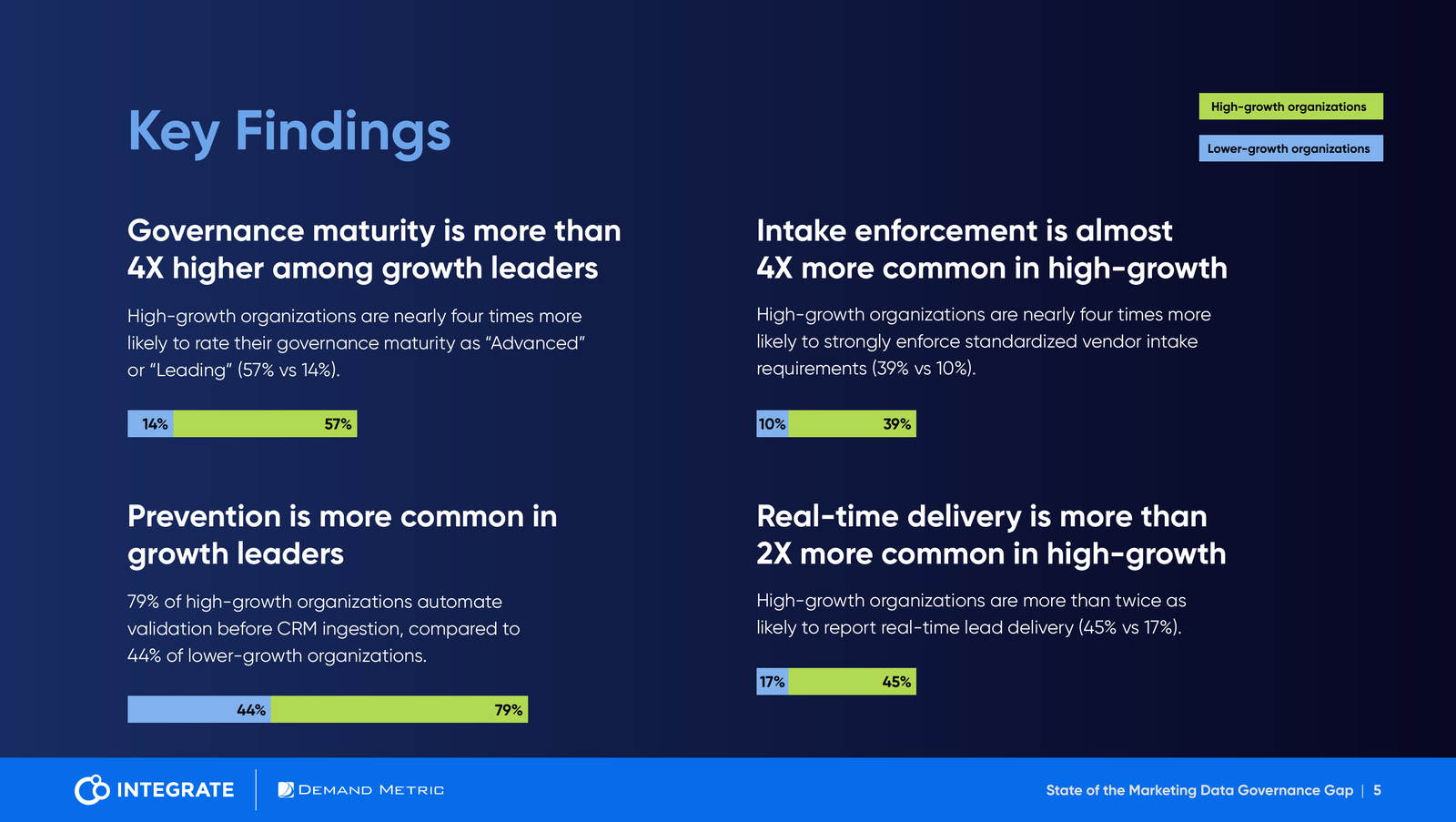
The report is careful not to claim that governance alone causes growth. The measures are self-reported, and association is not causation. But when the same directional difference appears at intake, validation, delivery, acceptance, budget, maturity, and AI oversight, it deserves executive attention.
The chain is intuitive:
Clearer standards upstream lead to cleaner records. Cleaner records can be validated and routed faster. Faster, more reliable handoffs build sales trust. Trusted data becomes more useful for analytics and AI.
This is governance as an operating system for commercial performance, not governance as a binder of policies that appears during an audit.
A stack is inventory. A system is flow.
B2B companies are not lacking technology. In the study, 72% reported using a data warehouse, 68% a customer data platform, and 48% ETL or ELT tools. Nearly half used ABM or intent platforms, and most captured demand through five or more channels.
Architectural sophistication is becoming mainstream.
Operational coherence is not.
A marketing technology stack can document the platforms an organization owns. It does not, by itself, prove that data moves between those platforms quickly, accurately, and with clear accountability.
Only 12% of respondents said their teams spend less than 10% of their time reconciling or cleaning data. Put differently, 88% devote at least one-tenth of team capacity to making data usable before optimization, routing, reporting, or modeling can begin. More than a third spend between 26% and 50% of team capacity on that work.
This is why the human integration layer is so expensive. The cost is not limited to salaries. It includes:
- latency while files wait to be processed;
- inconsistent judgment across people and teams;
- lost provenance when fields are changed without a reliable trace;
- compliance risk when consent and source data are incomplete;
- campaign waste when bad records enter activation systems; and
- sales mistrust when the same problems recur downstream.
The problem is not that humans are involved. Judgment, exception handling, and relationship context will remain essential. The problem is using people as APIs: carrying records between systems, repairing preventable errors, and translating schemas by hand as a normal operating model.
AI does not automatically remove this burden. Applied to a weak process, it can simply make the weak process run faster and at greater scale. A system that accepts poorly defined inputs, silently repairs them, and sends them downstream may look automated while becoming less observable and harder to govern.
The strategic question is therefore not, "Where can we add AI?" It is, "Which commercial flows are important enough to make trustworthy, observable, and fast?"
Marketing data governance is becoming commercial infrastructure
The word governance still carries the scent of bureaucracy. It sounds like a brake: more review, more controls, and more reasons to say no.
The report points to a different model. In a high-performing commercial system, governance is the mechanism that lets the organization move faster without losing trust.
Governance creates speed. Standardized intake requirements reduce downstream translation. Automated validation catches defects before routing. Real-time delivery shrinks the interval between buyer action and sales response.
Governance creates trust. A lead that arrives with complete source, consent, account, and contact information is easier for Sales to accept and act on. Sales acceptance rate is therefore not merely a sales metric. It is a downstream measure of how well the commercial data system works.
Governance creates optionality. When data is clean, governed, accessible, and consistently defined, the organization can use it across more applications, analytics models, and AI agents. Teams can compose new workflows without rebuilding the foundation every time.
This is why upstream validation matters so much. It shifts quality control from post-rejection repair to pre-routing prevention.
The commercial implication is significant: data quality is not a Marketing Operations hygiene issue. It is a conversion issue. The quality of the record affects whether it is accepted, how quickly it is worked, whether it can be measured, and whether future systems can learn from the outcome.
The AI layer makes the governance gap nonlinear
The timing of this research matters.
According to Gartner's 2026 CMO Spend Survey, CMOs are allocating an average of 15.3% of marketing budgets to AI, but only 30% report mature or fully developed AI readiness. Gartner's warning is direct: organizations risk buying AI faster than they build the data, processes, governance, and talent required to scale it.
McKinsey's 2026 State of AI describes a similar tension. AI is scaling across more enterprises, but broad financial impact still trails adoption. The small group achieving stronger results is more likely to redesign workflows, pursue growth as well as efficiency, and apply greater operational rigor.
The Integrate study shows what that readiness gap looks like inside the marketing-to-revenue flow.
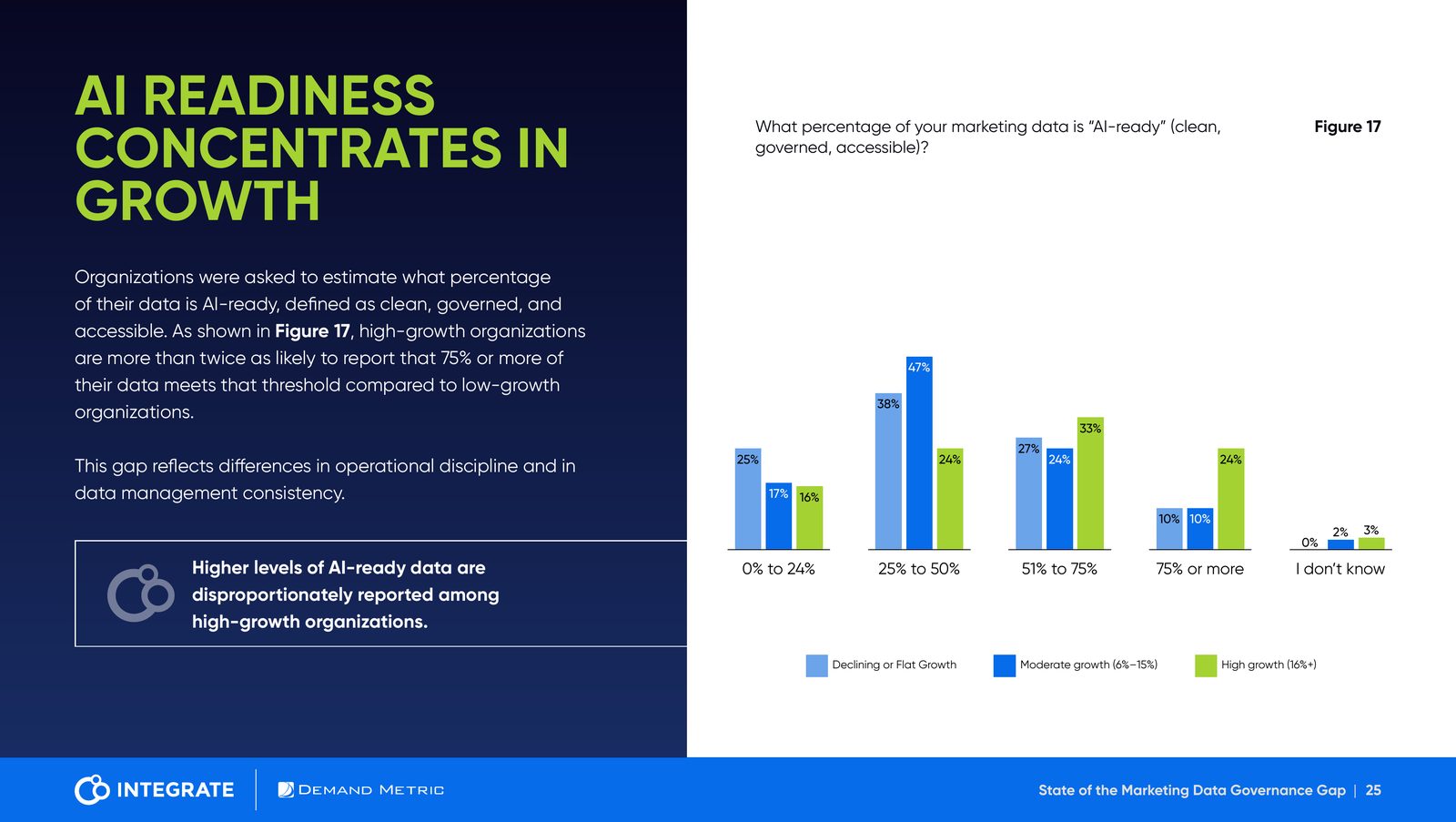
High-growth organizations were more than twice as likely as flat or declining organizations to report that at least 75% of their marketing data was AI-ready - defined as clean, governed, and accessible. Yet the high-growth figure was still only 24%.
That is an important reality check. Even many growth leaders have not completed the foundation.
Marketing technology is also moving toward a more fluid architecture. Scott Brinker has recently described a future in which a governed data and context layer supports a rapidly changing collection of commercial applications, custom automations, and independent agents. In that model, the stable core is not a single user interface. It is shared context, semantics, permissions, lineage, and business rules.
The Integrate findings reinforce that direction from the opposite end of the system. A governed core cannot compensate for uncontrolled inputs indefinitely. Before data becomes context for an AI agent, it must enter the organization with enough structure and provenance to be trusted.
CMOs should therefore distinguish AI adoption from AI readiness.
AI adoption asks how many tools, users, copilots, agents, and use cases the organization has deployed.
AI readiness asks what proportion of commercially important decisions can be supported by data that is accurate, permissioned, explainable, accessible, and connected to an accountable process.
The second question is less glamorous. It is also much closer to value.
What this means for the commercial team
The governance gap changes work across Marketing, Sales, RevOps, Commercial Operations, IT, Data, and Privacy. It is not solved by assigning another cleanup task to Marketing Operations.
The CMO becomes an architect of commercial flow
The CMO's responsibility expands from selecting channels and platforms to designing how information, decisions, and accountability move across the revenue system. This includes where standards are enforced, which exceptions require human review, what is measured, and who owns the handoff between teams.
The CMO does not need to own every system. But the CMO should ensure that the operating model serves growth, buyer experience, and trust.
Marketing Operations and RevOps become data-product teams
The highest-value operations teams will spend less time acting as ticket queues and more time managing reusable commercial data products: intake specifications, identity rules, validation services, routing logic, exception queues, lineage, and service levels.
Their job shifts from keeping the machinery running to making the machinery composable, observable, and reliable.
Demand Generation and Field Marketing own source quality, not just source volume
Lead sources should be evaluated on accepted pipeline, not raw volume. Vendor and event programs need explicit data contracts covering required fields, consent, timestamps, account matching, validation rules, delivery latency, and repair responsibilities.
A source that generates many records but consumes hours of reconciliation and produces low sales acceptance may be more expensive than the media invoice suggests.
Sales becomes part of the governance feedback loop
Sales rejection reasons are valuable data. When captured consistently, they can improve source selection, validation logic, ICP rules, routing, and scoring. When rejection happens through side-channel complaints or blanket distrust, the organization loses the signal.
Commercial teams should treat acceptance and rejection as structured feedback, not departmental opinion.
IT, Data, Legal, and Privacy move from gatekeepers to guardrail designers
As more agents and automations touch customer and prospect data, control cannot depend on reviewing every action manually. Policies need to be embedded in permissions, workflows, data contracts, and monitoring.
The future is not less governance. It is governance that operates at runtime.
The Q4 2026 CMO agenda
Q4 is not the ideal time to launch a two-year replatforming program. It is an excellent time to redesign a small number of commercial flows that matter to 2027 growth.
1. Select three revenue-critical data flows
Choose flows with high volume, high friction, or high strategic importance. Common candidates include event leads, content-syndication leads, partner referrals, demo requests, and paid-media conversions.
Map each flow from capture to sales action. Identify every handoff, transformation, queue, spreadsheet, manual decision, and error-repair step. Demand Metric’s Lead Qualification Process Diagram provides a simple starting structure for documenting roles and handoffs.
The goal is not a perfect enterprise map. It is clarity about where time and trust are lost.
2. Turn intake standards into data contracts
For each selected flow, define the minimum acceptable record. Include required fields, accepted formats, consent and source attributes, timestamps, account identifiers, validation rules, rejection conditions, repair ownership, and delivery service levels.
A data contract should be understood by the vendor, the platform, the operations team, and Sales. It converts assumptions into an enforceable operating agreement.
3. Move validation before MAP and CRM ingestion
Validate, standardize, deduplicate, and apply compliance rules before a record becomes part of the system of record. Quarantine exceptions rather than letting them contaminate campaigns, reports, scores, and AI context.
This is one of the clearest differences between growth tiers in the report, and it is often more achievable than a full-stack replacement.
4. Establish commercial data service levels
Track a small set of shared measures across Marketing and Sales:
- time from capture to usable lead;
- percentage of records validated automatically;
- exception rate and average exception age;
- vendor rejection and repair rate;
- completeness of source, consent, and provenance data;
- sales acceptance rate; and
- percentage of priority data that meets the organization's AI-ready standard.
These measures connect governance activity to speed, trust, and revenue execution.
Demand Metric’s B2B Data Management Maturity Model can also help teams establish an initial capability baseline.
5. Create an AI readiness gate for commercial use cases
Before scaling an agent or model, ask which data it will use, whether that data is permissioned and current, how outputs will be monitored, where explanations and logs will live, and who is accountable when the system encounters an exception.
The relevant question is not only whether an agent can access the data. It is whether it should, under which rules, for which decision, and with what evidence trail.
6. Fund governance as infrastructure in the 2027 plan
The report finds that high-growth organizations are more likely to treat lead management and governance as a core Martech investment category rather than a residual expense.
CMOs should make the business case using avoided rework, faster response, higher acceptance, lower media waste, better compliance, and greater reuse of data across AI and analytics. Governance should compete for budget as growth infrastructure, not as administrative overhead.
A practical sequence for the final quarter is straightforward:
September: choose the flows, establish baselines, and assign executive and operational owners.
October: implement data contracts and upstream validation for the first flow.
November: automate routing, create a visible exception queue, and connect sales feedback.
December: review service levels, lock 2027 funding, and formalize AI accountability for the use cases that depend on those flows.
Where marketing data governance is heading in 2027
Several developments are likely to converge next year.
Governance will move from periodic review to continuous execution. Standards, permissions, consent, validation, and lineage will increasingly be applied while data is captured and transformed, not inspected after the fact.
Data observability will become a commercial discipline. RevOps leaders will monitor freshness, completeness, schema changes, exception volumes, and flow latency with the same seriousness that digital teams monitor site uptime.
Vendor management will become data-product management. Commercial agreements will include machine-readable schemas, quality thresholds, provenance requirements, and repair service levels alongside volume and price.
AI agents will increase the value of stable semantics. The more interfaces and agents an organization uses, the more important shared definitions, permissions, and context become. A proliferating frontier requires a governed center.
Commercial and custom software will coexist. Teams will buy platforms, configure them, and build lightweight applications and agents around them. That flexibility will reward organizations with clean interfaces and punish those with undocumented dependencies.
Human work will move toward exception design and judgment. People will remain in the loop, but the goal should be to reserve their attention for ambiguity, risk, creative trade-offs, and relationships - not routine movement and repair of records.
The question CMOs should ask before Q4
As marketing enters the AI era, it is tempting to make the agent, model, or platform the center of the strategy.
A more useful starting point is simpler:
Where are our people still serving as the integration layer?
Every answer is a candidate for faster pipeline, lower operational cost, stronger sales trust, and better AI readiness.
The organizations pulling ahead will not necessarily have fewer tools. They will have clearer rules for how data enters, how it is validated, how quickly it moves, how outcomes are fed back, and how trust is preserved when humans and machines act on it.
That is the marketing data governance gap. Closing it may be the most practical AI strategy a commercial team can execute before 2027.
Download the 2026 State of the Marketing Data Governance Gap to benchmark your organization and review the full action plan.
Explore how INSIGHTS™ by Demand Metric turns original research into practical resources, executive conversations, and action.
Frequently asked questions
What is the marketing data governance gap?
The marketing data governance gap is the structural difference between organizations that merely own modern data and Martech systems and those that operate them with consistent intake standards, upstream validation, disciplined routing, clear accountability, and formal AI oversight. The 2026 Integrate and Demand Metric study found these practices were much more common among high-growth organizations.
Why does marketing data governance affect revenue growth?
Governance affects how quickly a usable lead reaches Sales, how often Sales accepts it, how much team capacity is spent on repair, and whether performance can be measured reliably. The study shows a strong association between higher governance intensity and higher revenue-growth tiers, although it does not establish causation.
How does data governance improve AI readiness?
AI systems need data that is clean, accessible, consistently defined, permissioned, and traceable. Governance supplies those conditions and defines how models and agents may use the data. Without them, AI can amplify errors, inconsistent definitions, and compliance risk.
Who should own marketing data governance?
Ownership should be shared. The CMO or commercial leader should sponsor outcomes and funding; Marketing Operations or RevOps should manage operational standards and service levels; IT and Data should support architecture and reliability; Legal and Privacy should define guardrails; and Sales should provide structured acceptance and rejection feedback.
Which marketing data governance metrics should CMOs track?
Start with time to usable lead, automated-validation coverage, exception rate and age, vendor rejection rate, completeness of consent and source data, sales acceptance rate, and the percentage of priority marketing data that meets an agreed AI-ready standard.
Methodology and sources
The 2026 State of the Marketing Data Governance Gap survey was administered online in Q1 2026. The final analysis included 245 qualified marketing, revenue operations, and commercial operations leaders across B2B and B2B2C organizations. CRM use was a qualifying requirement. Revenue-growth segments were based on self-reported year-over-year performance. Findings show associations and should not be interpreted as proof of causation.
Additional context was drawn from: