The Value Beneath the Skills: Preparing Marketing Teams for What Comes Next

Will you do your job the same way a year from now?
What about five years from now?
For marketing leaders, those questions quickly lead to others. What should our people learn? Which roles need to change? Where should we invest in development? How do we prepare for expectations that are still taking shape?
These questions were central to the work behind The ANA 2026 Marketing Capabilities Framework: A Human-Centered Skills Blueprint for the AI-Enabled Era.
I’m grateful to the Association of National Advertisers and its Talent Practice for the opportunity to co-author this research alongside Jerusha Harvey, EVP, Talent Practice. Bringing together the experience of people doing this work inside major organizations is one of the ANA’s real strengths, and it was a privilege to contribute.
The report was informed by contributions from leaders at organizations including PepsiCo, IBM, HP, Shell, Bayer, SAS, Equitable and Georgia-Pacific, alongside survey research with ANA members. The analysis included 130 qualified survey responses.
That breadth of experience matters. These leaders work across different industries, business models and organizational structures. Their perspectives help explain both what is changing in marketing and what continues to deserve our attention.
One message comes through clearly: the fundamentals of effective marketing remain durable. AI is changing how people apply them, how work moves through an organization, and what good performance requires.
An iceberg offers a useful way to understand why that matters.
Simon Bowen’s Value Iceberg explores three levels of value: the transactional request at the surface, the transformational outcome beneath it, and the timeless need at the base.
Here is how I apply that lens to marketing capability.
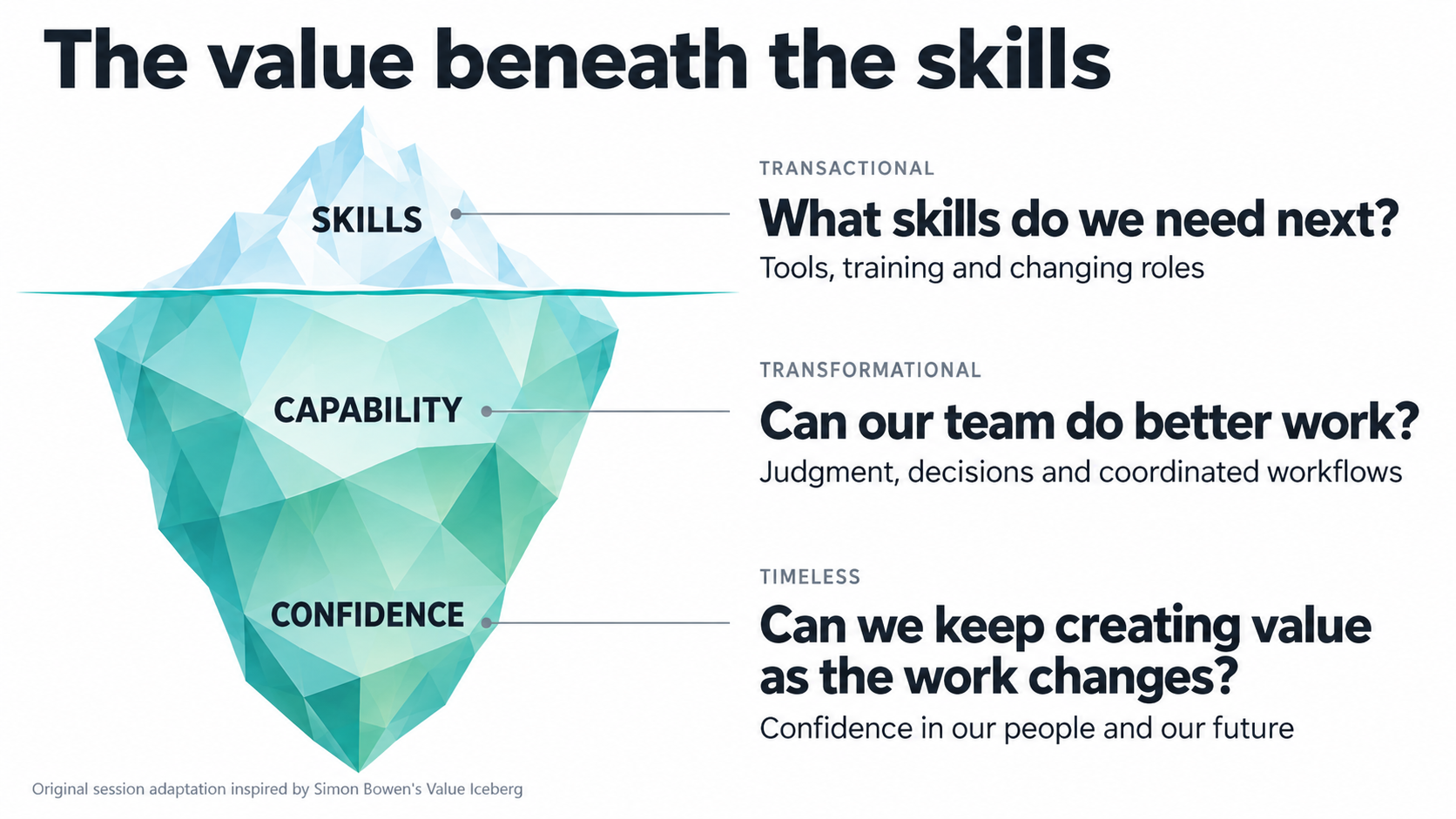
At the surface, the question is: What skills do we need next?
This is where many conversations about AI begin. Someone identifies a new tool. A team asks for training. A manager adds AI proficiency to a job description.
These are reasonable responses. People need opportunities to learn, experiment and understand what the technology can do.
The limitation is that these activities tell us relatively little about what happens afterward. A training completion record tells us someone attended. A certification tells us someone has captured enough knowledge to successfully pass a test. Neither, on its own, tells us how effectively that person can apply the technology to a meaningful marketing challenge.
The next question takes us below the surface: Can our team do better work?
Imagine a team using AI to develop a campaign brief.
Producing a first draft may become much faster. The team still needs to determine whether the customer insight is credible, whether the proposition is distinctive, and whether the brief gives an agency useful direction. Someone needs to recognize a confident claim that the evidence does not support. Someone needs to make the tradeoff when an interesting creative idea pulls the brand away from its positioning.
Those decisions depend on capabilities that extend well beyond operating the tool.
They also depend on how the work is organized. Who reviews the output? What does that person assess? When should a specialist become involved? What can a junior marketer decide independently, and where would coaching help?
At this level, development has a concrete purpose: improve what people can accomplish in the work that matters.
Then we reach the deeper question: Can we keep creating value as the work changes?
For an individual marketer, this can be deeply personal. Will my experience continue to matter? Where should I put my learning effort? How do I build a career when parts of the work I learned to do are becoming automated?
For a manager, it becomes a responsibility to others. How do I help my team adapt? How do I give people opportunities to develop judgment? If AI reduces the routine work through which junior marketers once learned, what experiences should take its place?
For a marketing leader, it becomes a question of confidence in the organization. Can we trust our team to make sound decisions, protect the brand and deliver as expectations change?
That confidence develops through experience. People apply a capability, receive feedback and see themselves making progress. Managers gain evidence of what the team can handle. The organization learns how to respond to a new challenge.
This is the enduring value underneath the skills conversation: people who can continue to contribute, and an organization that knows how to help them do it.
The ANA framework gives leaders a shared language for working toward that outcome.
It identifies foundational skills in which every marketer needs some fluency, including data and analytics, technology and AI, storytelling, critical thinking, and responsible decision-making. The depth required varies by role.
It also organizes the broader capabilities a marketing organization needs: how people think and collaborate; how they understand customers and build brands; how they use data and technology; how they meet their responsibilities; and how they coordinate the organization’s work.
These capabilities come together in everyday assignments. A product launch, for example, requires customer understanding and creative judgment, supported by evidence, clear ownership and appropriate oversight. Improving one part of that work can expose a need elsewhere.
The 2026 update makes several expectations more explicit. Technology and AI acumen and critical thinking appear among the foundational skills. AI enablement appears within the data and technology capability area. Workflow orchestration recognizes the growing need to design how work happens across people, AI tools, data, agency partners and approval processes.
The framework provides an industry reference that organizations can adapt to their own priorities. Its usefulness comes from the decisions it helps a team make.
Consider a team whose campaign approvals take too long. The initial request might be for AI training to speed up content production. Looking more closely could reveal that the largest delays occur because briefs are unclear, reviewers apply different standards, or nobody knows who owns the final decision.
The capability investment would then need to address those conditions as well.
A useful starting point is to choose one business priority and examine the work it requires. What must people be able to do well? Where is the evidence of their current capability? Where would development, a revised role expectation or a better workflow make the greatest difference?
That is the connection I care about at Demand Metric: helping people apply what they learn to work that matters, and become more capable through the experience.
It is also a conversation I’m looking forward to continuing with Jerusha and Florian Pequignot, VP, HR-Brand at P&G, at the ANA Masters of Marketing Conference on October 22. Our session, From Capability to Growth: How Brands Are Building Marketing Talent Strategies That Deliver, will explore what these choices look like in practice.
If you are thinking about your team’s next development investment, I encourage you to explore the ANA’s full Marketing Capabilities Framework.
Then bring one question back to your team:
What do we need to become capable of doing and what would that make possible?