The 86/12/6 Paradox: Omnichannel's Next Era Is Connected Execution
The central finding, in one paragraph
Omnichannel commerce has stopped being a channel strategy and become an enterprise operating model. In The State of Omnichannel Commerce 2026-2027, a global study of 408 qualified commerce decision-makers at organizations with more than USD $100 million in annual revenue, 74% rank omnichannel as their first or a Top 3 priority for the next 12 months, and 86% say they are satisfied or better with current performance. Yet only 12% describe their operations as optimized, just 6% have end-to-end visibility across channels and systems, and 55% still report high or very high manual effort. We call the distance between confidence and connected execution the Omnichannel Execution Gap.
Omnichannel commerce has a naming problem.
The term still sounds like a front-end channel strategy: connect the website to the store, add a marketplace, support social commerce, make the experience feel consistent. That was a useful definition for the first phase of omnichannel maturity.
It is no longer sufficient.
Today, omnichannel is the operating model for coordinating demand, product data, pricing, promotions, inventory, orders, fulfillment, delivery, returns, customer data, and local market requirements across a growing network of channels and partners.
In other words, the first era of omnichannel was about presence. The next era is about coherence.
That distinction matters as CMOs enter the final quarter of 2026. Q4 is simultaneously a period of execution pressure, budget allocation, and 2027 planning. The decisions being made now will determine whether AI, marketplace growth, and customer-experience investments become connected capabilities - or simply add another layer of complexity.
What is the omnichannel execution gap?
The most striking result in the research is not a single percentage. It is the contradiction between several of them.
- 86% of respondents are satisfied, very satisfied, or extremely satisfied with omnichannel performance.
- 65% of technology respondents are very or extremely confident their stack can scale.
- Only 12% say their omnichannel operations are optimized with unified visibility and orchestration.
- Only 6% report end-to-end visibility across channels and systems.
- 55% report high or very high manual effort managing orders, inventory, and fulfillment.
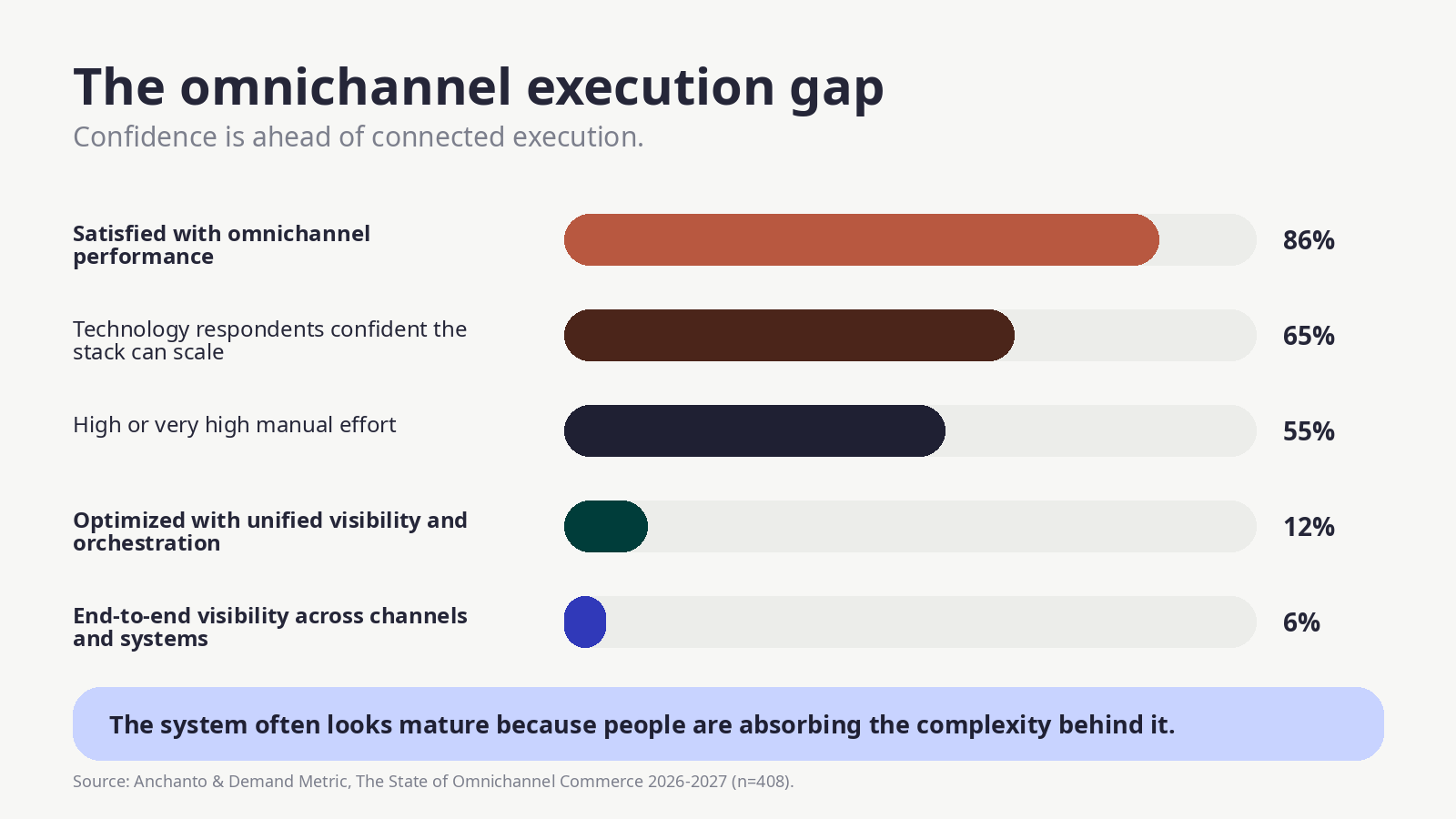
This is not evidence that companies are failing. It is evidence that their people have become exceptionally good at compensating for gaps in the operating model.
Spreadsheets bridge systems. Email moves exceptions. Teams reconcile inventory manually. Local operators improvise around marketplace rules. Customer-service teams repair problems that began upstream. The business keeps moving because employees are absorbing the complexity behind the scenes.
That makes manual effort more than an efficiency issue. Manual effort is deferred architecture.
A workaround can keep one handoff moving. It cannot become a scalable global operating model. As channel, market, and fulfillment complexity grows, the cost of those workarounds rises, their fragility increases, and the organization becomes more dependent on institutional knowledge held by a relatively small number of people.
The danger is not that omnichannel stops working tomorrow. The danger is that it becomes progressively more expensive, brittle, and difficult to improve.
Why does channel growth create a coordination problem?
Modern commerce is already multichannel by default. The study found that 86% of commerce leaders manage three or more sales channels per country, while 38% manage five or more. The portfolio commonly includes brand websites, online marketplaces, physical stores, social commerce, B2B e-commerce, and mobile apps.
Fulfillment is just as distributed. Ninety-one percent fulfill from at least two locations per country, and 46% fulfill from five or more.
The implications are easy to underestimate. A new channel does not add one new workflow. It introduces new dependencies across product data, pricing, promotions, inventory availability, order routing, service levels, returns, reporting, and customer support. A new fulfillment node adds allocation rules, carrier choices, delivery promises, exceptions, and local constraints.
For years, technology leaders described commerce architecture as a stack. Increasingly, it behaves more like a graph: a network of systems, decisions, teams, partners, and handoffs. Every new node creates more connections that must be governed.
This is why complexity compounds rather than merely accumulates.
It also explains why the next investment cycle is so revealing. Marketplace integrations are the leading planned investment area at 33%, followed by fulfillment integration at 30%, advanced analytics at 26%, omnichannel store fulfillment at 24%, inventory visibility at 22%, and reporting and analytics at 19%.
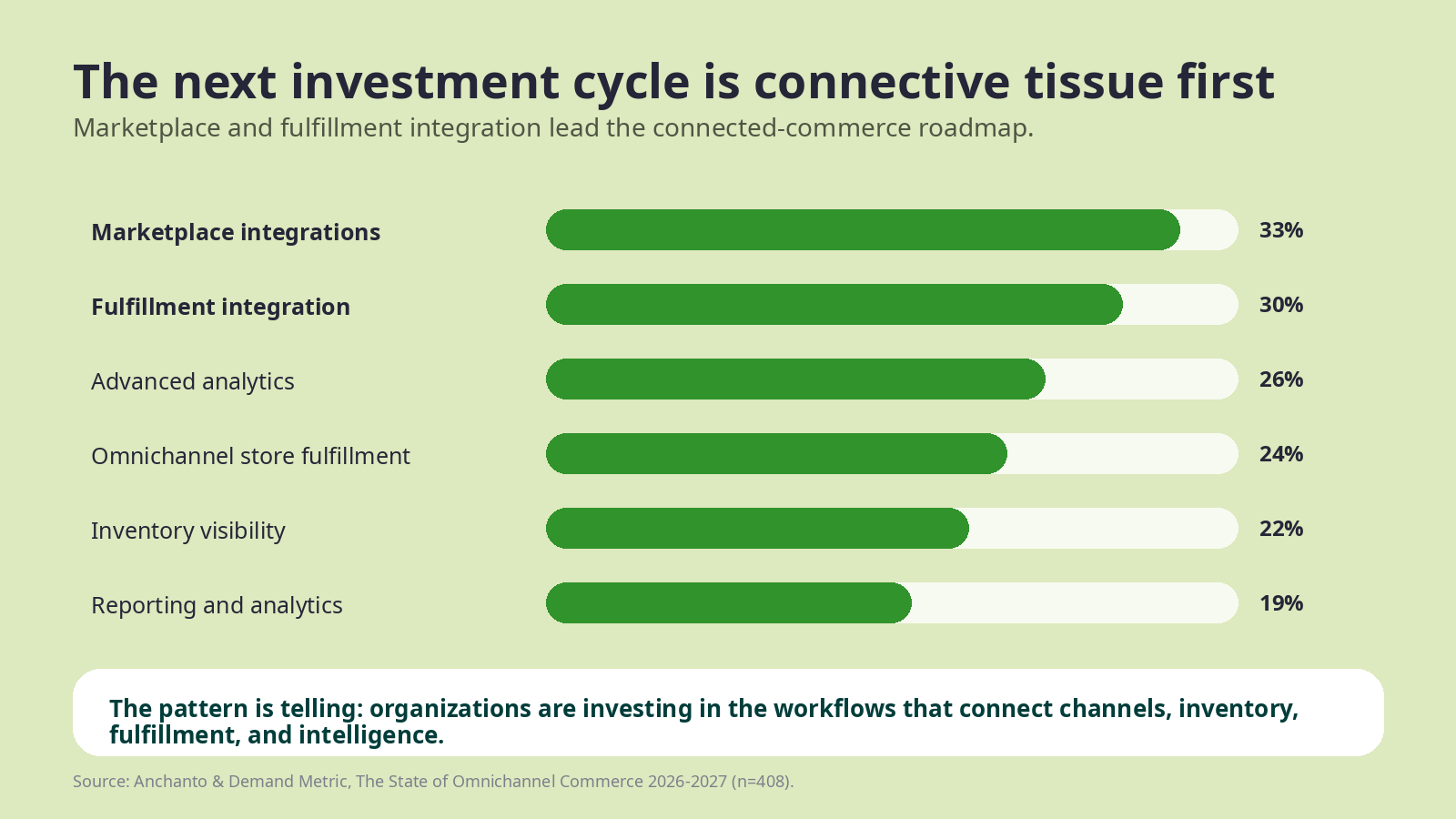
The market is not simply asking for more applications. It is asking for connective tissue.
The next commerce stack will be judged less by how many capabilities it contains and more by how effectively it coordinates decisions across them.
Customer experience has moved downstream
One of the most important implications for CMOs is that customer experience can no longer be managed primarily through messaging, design, personalization, and front-end interactions. The old boundary between marketing technology and commerce operations is becoming less useful.
Customers do not experience an organizational chart. They experience whether the product was available, whether the delivery promise was accurate, whether the order arrived on time, whether a return was simple, and whether the company communicated clearly when something went wrong.
In the study, disconnected systems most often create fulfillment or delivery issues (46%), delayed order processing (39%), and inventory inaccuracies or overselling (36%). They also create limited performance visibility, higher operating costs, slower launches, and inconsistent customer experiences.
To the customer, there is no front office and back office. There is one promise - and whether the company kept it.
That changes the CMO's remit. Marketing may not own inventory, order management, fulfillment, or carrier operations, but it does help create the demand and expectations those functions must satisfy. When marketing and commerce teams optimize acquisition without understanding inventory position, fulfillment capacity, returns, or margin, they can generate revenue on paper while creating operational strain and customer disappointment downstream.
Promotions are a useful example. They influence sales, but they also affect margin, inventory levels, fulfillment capacity, returns, repeat purchase, and marketplace performance. Yet only 12% of organizations say they can optimize promotions across channels using unified data and near-real-time insight.
A modern commercial scorecard therefore needs to connect campaign and channel metrics to operational and economic outcomes: contribution margin, inventory availability, delivery-promise accuracy, cancellation rates, return drivers, cost to serve, customer retention, and repeat purchase.
Marketing creates the promise. Connected commerce determines whether the business can keep it profitably.
Why will AI increase the value of connected commerce?
AI and data capabilities are the leading transformation priority in the study, selected by 53% of respondents. But the AI use cases commerce leaders value most are notably practical:
- 46% prioritize promotion and pricing effectiveness.
- 42% prioritize marketplace performance visibility.
- 39% prioritize inventory and fulfillment prediction.
- 37% prioritize identifying the channels that drive repeat purchase.
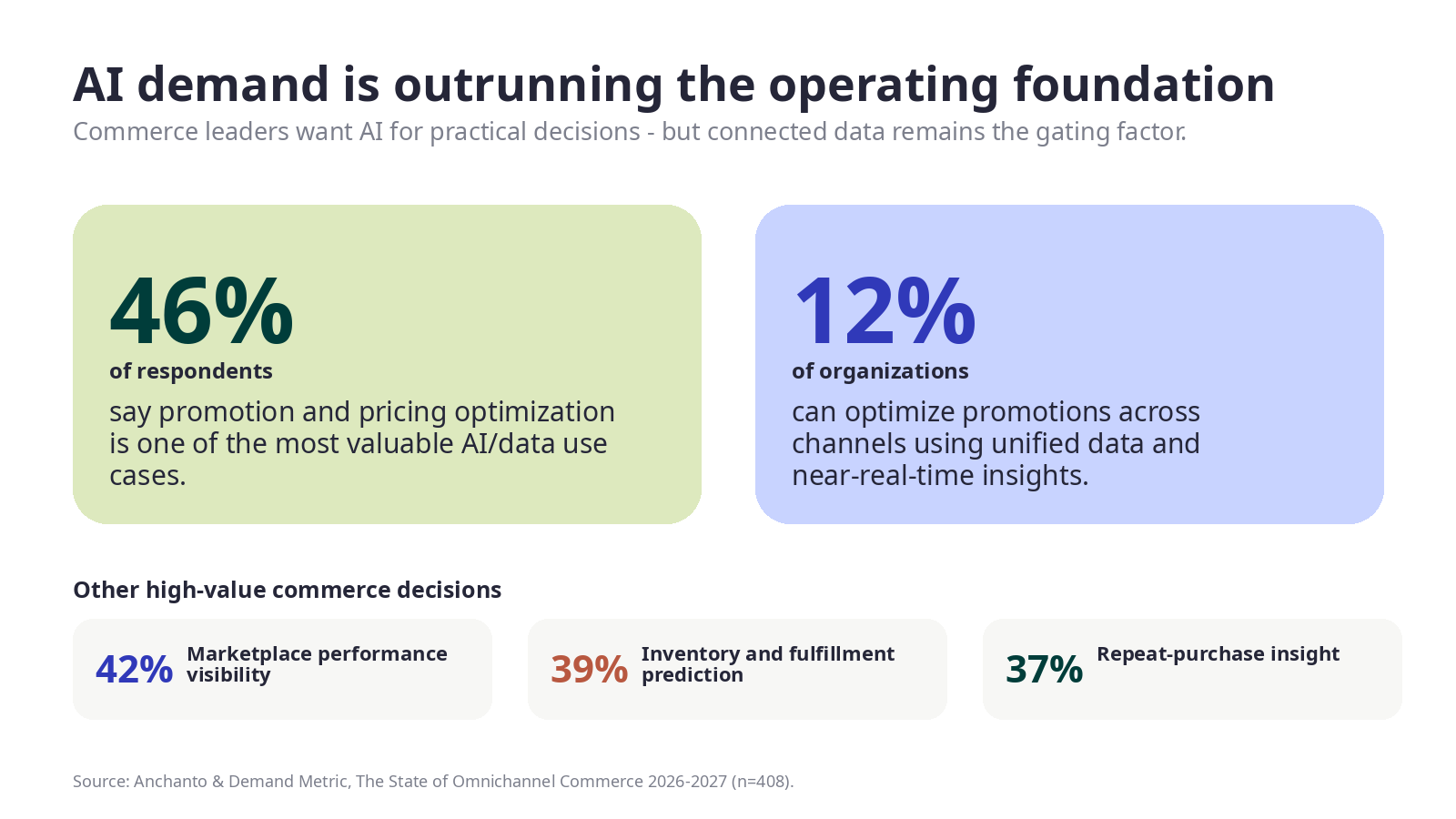
This points to a meaningful shift. In commerce, some of the most consequential AI applications will not be content engines. They will be decision engines.
They will help determine where inventory should sit, which orders should route to which fulfillment node, how a promotion affects margin and capacity, where marketplace performance is deteriorating, which customers are likely to buy again, and where revenue leakage is occurring.
But AI needs more than data in the abstract. It needs connected context and an executable workflow.
A useful way to think about an AI-enabled commerce capability is as a closed decision loop:
- Sense: Gather trusted signals from channels, marketplaces, inventory, orders, fulfillment, customers, and partners.
- Decide: Apply business rules, analytics, predictive models, or AI to recommend an action.
- Act: Execute the decision through connected commerce and operational workflows.
- Learn: Measure the commercial, operational, and customer outcome and feed it back into the next decision.
Many organizations have pieces of this loop. Far fewer have connected it end to end.
That is why AI does not eliminate integration debt. It makes the quality of the operating model more consequential. Automating an undefined handoff or acting on inconsistent data can simply create mistakes faster and at greater scale. As commerce AI becomes more agentic - moving from recommendations toward actions - clear data, decision rights, guardrails, and exception workflows become even more important.
The strategic sequence is not “AI first, integration later.” It is to improve connectivity and intelligence together, beginning with a small number of high-value decisions where the data, workflow, owner, and outcome can be clearly defined.
What does connected commerce mean for commercial teams?
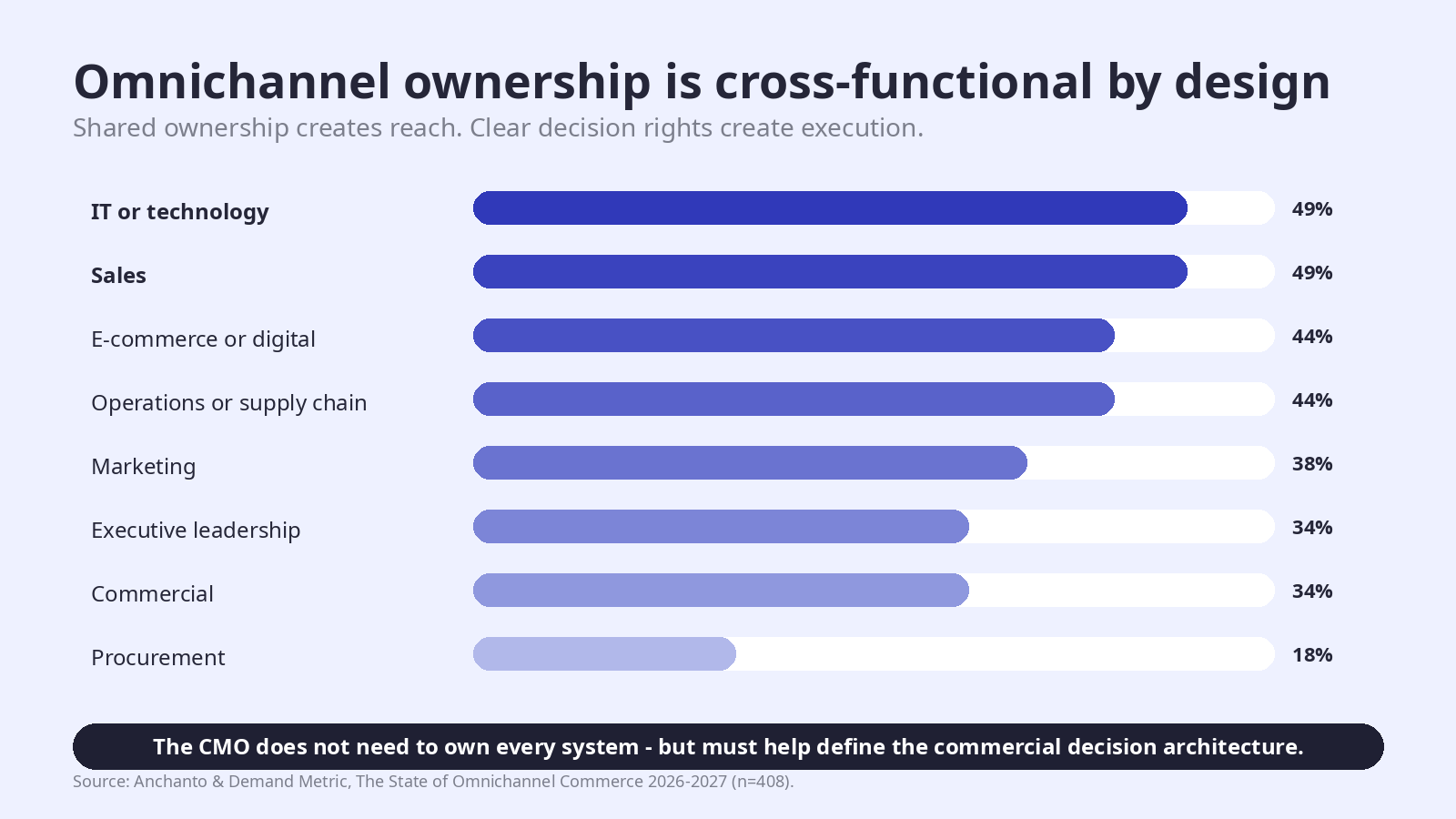
The research shows that omnichannel ownership is already cross-functional. IT and sales are each cited by 49% of respondents, e-commerce/digital and operations/supply chain by 44%, marketing by 38%, and executive leadership and commercial teams by 34%.
This is healthy. Omnichannel genuinely does require multiple functions.
But shared ownership and coordinated execution are not the same thing. Cross-functional can easily become a polite synonym for ambiguous.
Commercial teams need a shared decision architecture: clarity about which outcomes matter, which signals inform them, who has authority to act, which systems execute the decision, and how the organization learns from the result.
For example:
- Who decides whether a new marketplace is attractive enough to enter - and whether the operating model is ready to support it?
- Who owns a promotion when it increases revenue but reduces margin, creates stockouts, or overwhelms fulfillment capacity?
- Who determines the customer promise for delivery, returns, and post-purchase communication?
- Which decisions are globally standardized, and which can be adapted by local teams?
- Who owns exceptions when an automated workflow cannot complete the process?
The CMO does not need to own every answer. But the CMO is uniquely positioned to connect the customer promise, growth agenda, commercial economics, and cross-functional operating model.
In that sense, the emerging role is less “owner of the marketing funnel” and more architect of the commercial decision system.
What should CMOs prioritize in Q4 2026?
Q4 should not produce another disconnected technology wish list. It should be a sequencing exercise that connects 2027 investments to explicit business outcomes.
1. Define the omnichannel ambition in business terms
Decide what the organization is actually trying to improve: profitable growth, customer retention, cost reduction, market expansion, visibility, customer experience, margin protection, or reduced revenue leakage.
These outcomes are related, but they are not interchangeable. A roadmap built around a clear economic and customer objective is easier to prioritize than one built around a list of features.
2. Benchmark confidence against operational reality
Use the execution gap as a diagnostic. Do not rely only on satisfaction or platform confidence. Establish a baseline across five dimensions:
- optimization and orchestration;
- end-to-end visibility;
- manual effort;
- friction at cross-functional and cross-system handoffs; and
- the commercial impact of errors, delays, returns, and revenue leakage.
A company can be performing reasonably well today and still be structurally unprepared for the next stage of growth.
3. Map the commerce operating graph
Document the channels, marketplaces, fulfillment nodes, inventory sources, carriers, payment flows, systems, partners, local requirements, and teams involved in the customer journey.
Then identify the handoffs where orders slow down, inventory becomes unreliable, promotions lose economic visibility, exceptions multiply, or teams fall back to manual reconciliation.
The goal is not to produce a perfect architecture diagram. It is to make hidden dependencies visible enough to prioritize the few connections that matter most.
4. Choose AI decisions, not AI demonstrations
Select two or three decisions where better intelligence could materially improve an outcome. Promotion and pricing, marketplace visibility, inventory positioning, fulfillment prediction, and exception management are strong candidates because they connect directly to revenue, margin, cost, and customer experience.
For each use case, define the required data, workflow, decision owner, guardrails, action, and feedback metric. This turns AI from a pilot into an operating capability.
5. Fund the connective tissue
The investment priorities in the research are directionally clear: marketplace integrations, fulfillment integration, analytics, store fulfillment, inventory visibility, and reporting.
These capabilities may not always generate the most dramatic boardroom demo, but they create the foundation for scalable automation, better customer experiences, and more reliable AI.
6. Balance central standards with local flexibility
The dominant operating model in the study combines central control with local adaptation. That is the right tension to manage.
Standardize the core: data definitions, integration patterns, decision rules, governance, security, and performance measurement. Adapt the edge: marketplace requirements, regulations, carriers, payments, partners, fulfillment rules, language, and local customer expectations.
The goal is not universal uniformity. It is localization without fragmentation.
7. Treat Q4 execution as a live diagnostic
For organizations entering peak selling periods, Q4 will expose where the operating model bends or breaks. Capture those exceptions systematically.
Do not let teams solve the same problem heroically and then forget it. Track the manual interventions, inventory mismatches, delayed orders, promotion conflicts, customer-service escalations, and local workarounds. They are not merely operational noise. They are evidence for the 2027 roadmap.
The next competitive advantage is coherence
Omnichannel commerce is entering a more consequential phase.
The first phase rewarded companies for expanding their reach. The next will reward them for coordinating that reach: connecting customer demand to inventory, orders, fulfillment, delivery, returns, local execution, and commercial learning.
AI will accelerate the transition, but it will not make operating-model questions disappear. It will force organizations to answer them more explicitly.
The companies that move ahead will not necessarily be those with the most channels, the largest technology stacks, or the greatest number of AI pilots. They will be the companies with the shortest, most reliable distance between signal, decision, and action.
As CMOs finalize 2027 priorities, the central question is no longer, “Where else should we sell?”
It is, “Can the entire business execute the customer promise as one connected commercial system?”
The advantage will not come from being everywhere. It will come from making everywhere work as one business.
For the complete benchmarks and maturity model, read The State of Omnichannel Commerce 2026-2027.
Learn More about INSIGHTS™ by Demand Metric
See how Demand Metric turns original research into market authority, practical resources, executive engagement, and measurable next steps.
Frequently asked questions
What is the omnichannel execution gap?
The omnichannel execution gap is the difference between an organization's confidence in its omnichannel performance and its actual ability to coordinate channels, systems, inventory, fulfillment, data, and teams through connected workflows. The Anchanto and Demand Metric study found high satisfaction alongside low optimization, limited end-to-end visibility, and substantial manual effort.
Why is omnichannel now a CMO issue?
Omnichannel directly affects customer experience, growth, retention, margin, and revenue leakage. Marketing creates demand and sets customer expectations, while inventory, fulfillment, delivery, returns, and post-purchase communication determine whether the organization can meet those expectations profitably.
What should CMOs prioritize before 2027 planning is complete?
CMOs should define the business outcome for omnichannel investment, benchmark the execution gap, map critical handoffs, select a small number of high-value AI decisions, fund integrations and visibility, and establish clear cross-functional decision rights.
Why does AI require a connected commerce foundation?
AI creates value when it can use trusted operational data to recommend or execute a decision and then measure the outcome. Fragmented data, disconnected systems, and undefined workflows limit the quality, speed, and safety of AI-enabled commerce decisions.
Which connected-commerce capabilities are most likely to receive investment?
In the 2026-2027 study, marketplace integrations led planned investment, followed by fulfillment integration, advanced analytics, omnichannel store fulfillment, inventory visibility, and reporting and analytics.
Source: This article is based on The State of Omnichannel Commerce 2026-2027, published by Anchanto and Demand Metric. The study includes 408 qualified commerce decision-makers from organizations with more than USD $100 million in annual revenue across the Americas, Europe, Asia-Pacific, and the Middle East and Africa. Percentages are rounded. Read Anchanto's official study announcement.